We all know that people will read anything--jokes, advice, platitudes, aphorisms, anecdotes, anything--if it's printed on a picture and posted to Facebook. They won't necessarily believe it but they will read it.
Would this work for poetry?
How about putting this to the test? Let's post two poems by the same author to our Facebook pages, one simple text and the other on a photograph. Any two poems will do. If you'd like to use those below please feel free to do so (the author has given consent for this experiment). To participate, post the text...
Looking for Lorca
When Andalusian dogs don't bark Granada nights are calm, like this. No Cante Jondo violins call gypsy spirits. Caught in flight, no butterfly denies its mark. There are no New York trains to miss. Havana lingers. Franco wins no prize beyond this candle light.
Let five years pass before we speak of nightingales among these birds. You sang as if to mourn the sun that sank at five this afternoon. No lovers stray, no blood can leak from sutured scars or silphion words, but here, between the things undone, I like to think I found your moon.
...and then, in another Facebook post, post the image file or a URL to it.
What marks us as Pixel, Page or Stage poets is not that we excel at poetry production, promotion or performance, respectively, but that we suck at the other two. Otherwise, we could think of ourselves as "poets", sans qualification.
Even if we had the best forehand in tennis, would we expect to win Wimbleton without a backhand?
That overspecialization, in a nutshell, is why your poetry fails. And trust me, I know nutshells!
Put another way, during their travels, ancient Greek sophists¹ would be exposed to various philosophies and approaches. If we want an edge on our competition we need to become more sophisticated.
Some will tell you to "be teachable". Good advice, but you need to be far more proactive than that. One can be a great poet without a degree, without a passionate personality and, believe it or not, without a lot of imagination². There is one trait that all worthwhile writers share, though. My exhortation amounts to this:
Be curious.
It is downright tautological to say that, regardless of what poetry world you hail from, you will never become a well-rounded poet without absorbing lessons from the other two. Indeed, perhaps I should say:
Be bi-curious.
While I'm stating the patently obvious: our impressions of those other poetry worlds are probably negative but we need to put our preconceptions aside and learn what we can from them. As an example, let me start with the hardest sell:
You must perform your poems. In public.
Someday I'll list the top 10 reasons why this is so but, for now, I'll cooncentrate on those that pertain to impressing an author or writing contest judge. In truth, there are dozens of good reasons to perform and only one reason not to: you're shy. So am I. Nevertheless, shyness isn't a reason. It's an excuse.
"Why do I need to perform my work for a writing contest?" you ask.
Because the adjudicators will. If they are even remotely competent, judges and editors will read the poems aloud to themselves, to each other, or, ideally, have someone read the entries to them. They need to hear the sounds. The only way you might discern how this will go is to read/perform them for a test audience and guage the reaction. Since you will need to be looking the bastards in the eye to see their physical response, we eliminate the "read" option; you must memorize and perform your work onstage. With practice you will see which parts of your poems aren't working, just as you will be able to distinguish obligatory/polite from enthusiastic applause.
Poetry is, essentially, memorable writing. If your pieces are difficult to memorize you might need to revise them or submit different material. Judges and editors usually take weeks to make their decisions. If they can't remember lines, images and metaphors of your work as they revisit it you will not prevail.
Bottom line: If it comes down to a choice between your poems and those of someone who can please a live audience you will lose every time. On the other hand, capturing an audience just once will change your view of every line of poetry you read or write for the rest of your life.
If you spend every moment in fear of cats, birds of prey and nasty kids with slingshots or air rifles you'll understand why there are no extroverted squirrels. Not for long, at least.
Are there things we can do to alleviate the effects of shyness and help us succeed onstage? Aren't there a lot of successful introverted actors and television personalities? Indeed, there are. All introverts share a single trait: they don't like expressing their personal off-the-cuff opinions in front of people. Actors have a script and a persona, such that it really isn't them or their views we are seeing. This explains why some actors can do Shakespeare but not a simple interview. Thus, we have our first dictum for bashful performers:
1. Know your script.
Carry your poem around with you. You might even wear one of the wrist pads that NFL QBs use. Every moment alone is a chance to practice. Turn your damned television off--at least until Game of Thrones is on. It's not enough to be familiar with your work; you need to be comfortable with it. You need to know your work so well that you could recite it in a coma. Practice, practice, practice. Ditto your performance. Use mirrors, video cameras and any family member who doesn't escape fast enough when you need a test audience.
2. Just the facts, ma'am.
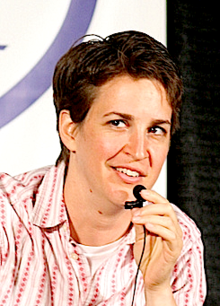
Rachel Maddow
Compare the gregarious Ed Shultz to his fellow MSNBC commentator, the incomparable Rachel Maddow. Ed operates on a few basic factoids and builds his TV talk show conversation around them. The painfully shy self-professed nerd, Rachel Maddow, provides fact after fact--more than the rest of her network, with Fox thrown in for good measure. Then she looks at us. If the storyline is too convoluted, she'll begin her next sentence with "In other words..." For the most part, though, she leaves the watchers to draw their own conclusions, albeit with considerable help from Ms. Maddow's data selection.
Avoid rants and diary entries. Find an interesting narrative and stick with it.
3. Choose a cozy open mic.
Save slams for later.
4. Go alone or with someone who has seen you at your worst.
This may seem odd, but friends can raise your anxiety level.
5a. Sign up for a spot just before the break (if any).
This gives you time to study everyone's body language before you go on and before people leave at half-time (rude, but it happens). Find audience members whose mannerisms, movements and facial expressions are easy to read. (Roughly: leaning forward and smiling, good; leaning back and snoring, bad.) Focus on these people during your preformance.
5b. Check out the talent.
As per Sturgeon's Revelation, 90% of the performers there will be awful. Draw some comfort from the fact that, no matter how badly things go, you won't be much worse than the average participant. No, really.
6. Poetry means never having to say you're sorry.
Skip the introductions, explications or annotations.
7. Adjust your poem's length to fit.
There is a set amount of time (3 minutes?) allotted to you. Plan to use about 80% of it. You don't want to feel hurried.
8. Don't eat beforehand. Bring antacids.
Nervous stomachs can be an unwanted complication.
How do you know you've done well when everyone is going to clap and thank you for coming? Aside from interpreting their body language, you hope that people will refer to your performance when they express their desire to see you again. The ultimate compliment--which is extremely rare--would involve having an attendee ask to see the text of your poem.
At a future date I hope to discuss what Pixel and Stage poets can learn about promotion from the PoBiz.
Footnotes:
¹ - For what it's worth, Americans are not the first to believe that teachers shouldn't be paid well.
² - Hold that thought. This will be the subject of a subsequent post.
While the rest of the world continues to prefer metrical, rhyming narratives editors, judges and academics adore comparisons: analogies, juxtapositions, symbolism, contrasts, similes and metaphors. Especially metaphors. Metaphors are like honey-glazed catnip to these people. Indeed, the reason analogy plays such a small role in poetry is that similes and metaphors do the same thing more succinctly.
The bad news, then, is that if you're going to impress judges or editors you will have to come up with scintillating, original metaphors.
The good news is that this requires remarkably little effort.
Hold this thought for a moment: "Once you know the answers the questions are simple."
Similes:
A simile says that something is similar to something else. Typically, the word "like" or "as" is employed. Suppose you want to describe a setting as being in a particular hemisphere during extremely troubling, portentous times. Think of something disturbing. What could be more so than a sick baby? How does one make it clear the action takes place south of the equator? By having September be spring, not fall. Put this together and you have:
"September came like winter's ailing child."
Now suppose you want to describe a situation where the police and armed forces form a tight conspiracy against their government because it has nationalized the copper mines. Nothing could be more obvious than:
"As close as coppers..."
Metaphors:
Metaphors are more hyperbolic than similes, stating directly or indirectly that one thing is something else. Think of how a child might revere his grandmother and consider her current location to be the family home, much like the famous song "Papa was a Rollin' Stone. Wherever he laid his hat was his home." Think of someone who is worshipped and something that carries its abode around with it and, voilà!, you have:
"Of course, you are a turtle god."
Now suppose the fix is in for a physician. It takes little imagination to come up with a "verb modification" like:
"...every doctored moment lied."
There's nothing new here. About 3000 years ago Homer (not Simpson) sat down, wondered how to describe the intoxicating, addicting, mysterious effect of the port-colored ocean and effortlessly produced the greatest "noun-modification" metaphor of all time:
"...the wine-dark sea."
As poets on Usenet used to say: "Hey, this poetry shit is easy!"
Actually, these comparisons are not poetry techniques. They are logical constructs found in any explanatory text (e.g. "A Brief History of Time" by Stephen Hawkings uses many of them).
Symbolism:
There are two myths about symbolism that need to be dispelled:
Symbolism is common, if not downright ubiquitous.
We get this impression from our English teachers constantly asking us: "What does this poem mean?" (In my perfect world posing this question would, itself, be a fireable offense.)
In fact, symbolism is comparatively rare in English poetry. This is because English is an "open", Borg-like language that uses a myriad of synonyms rather than cross-referencing its terms through iconic metaphors. By contrast, Japanese developed in an isolated environment where most significant terms would be associated with colors (think "green with envy" here), animals (e.g. "sly fox"), seasons ("our autumn years") or other common noumena or phenomena. (This, incidentally, is a key reason why haiku and haibun do not work as well for anglophones as for native Japanese. Our poetry isn't symbolic because our language isn't.)
Symbols should be undefined.
"Undefined symbols" is interchangeable with "meaningless and pointless distraction". Very few poets today inspire enough readership trust for amphigouri. Do they really think we have nothing better to do than sit around like sophomoric stoners and guess at what they're writing about?
Symbolism is far more common in repressive societies. For example, if Soviet era samizdat readers didn't know which animal character corresponded to which hated official the whole process would become pointless.
Connections:
Many of the tricks we've discussed in this series so far are subtle: diaeresis, palindromics, curginas, corata, et cetera. Some of the crudest and laziest approaches, though, can be the most effective.
Juxtapositions:
Poetry being a no-frills form of communication, the mere mention of any two items, individuals or events or of the same expression twice (why not use synonyms?) invites the audience to compare the pair. Haiku is built on such juxtapositions. Until we see that "Beans" is an acrostic, at least, we wonder what the relationship is between yellow beans in the second stanza and the central figure in the first.
Allen Ginsberg's famous prose poem "Howl" relies almost entirely on anaphora: the repetition of words like "who...", names like "Moloch..." or phrases like "I'm with you in Rockland..." at the beginning of many lines. In poetry or rhetoric, anaphora can be an excellent way to built tension from one iteration to the next.
If done judiciously, anaphora can have both a chanting and enchanting effect.
Anadiplosis:
Everyone is familiar with "The Skeleton Song", including many who wish they weren't.
Anadiplosis is a fancy term for using an expression from the ending of one sentence to begin the next. It can be a very effective, economical way to create links in a narrative chain.
Your face was always saddest when you smiled.
You smiled as every doctored moment lied.
You lie with orphans parents, long reviled.
The Dreaded List Poem:
When a poetry fan wakes up in a cold sweat chances are good that they were having a nightmare about the "list" poem that put them to sleep in the first place. These itemizations rarely work--especially on the page--unless their particulars increase in intensity and/or move the narrative along with subtle differences in the items or presentation. Most often, the details become blurred; the listener's processing center shuts down under Information Overload, such that only the tone, mood and pace survive.
Michael Ondaatje's "Sweet Like a Crow" is a successful list poem. "Remedies for Vertigo" by Walter Bargen is so full of lists that it seems like an encyclopedia of interesting lines, none of them contained in a poem worth reading.¹
Conclusion:
Repetitions of words or phrases at the beginning (anaphora), end (epistrophe) or end and beginning (e.g. anadiplosis or symploce) of sentences, of sentences ("repetends") in whole or part, and even stanzas (choruses) are the stock and trade of the performing poet. They are to slam judges what metaphors are to editors and writing contest judges: catnip.
Footnotes:
¹ - That said, the chilling story poem, "Flight Lessons", from "Remedies for Vertigo" is worth the price of the book.
Please feel free to comment or ask questions below or, failing that, mark the post as "funny", "interesting", "silly" or "dull".
If you would like to contact us confidentially or blog here as "Gray for a Day" please use the box below, marking your post as "Private" and including your email address; the moderator will bring your post to our attention and prevent it from appearing publically.
Stories abound of great poems or poets being rejected by editors. The greatest poem of the 20th Century was initially put aside because the editor didn't know it was metrical and thought it was obscure rambling. Ironically, the greatest piece [so far] in the 21st Century was rejected by the same outlet and under the same misapprehension: that it was non-metrical and too obscure despite the fact that its theme was, literally, spelled out for them.
"How can this happen?" you might ask. "Twice, no less! Are they crazy? Stupid? Utterly lacking in taste?"
Too many people seem to think that contests and periodicals have dozens of screeners and judges/editors waiting for submissions to trickle in, each of which will be studied like the Dead Sea Scrolls. Wrong at every level. Judging and editorial staffs are always undermanned, almost always receive far more entries than expected and, with a deadline looming, have nowhere near the time for a "close read" of each poem or manuscript.
Typically, like a sports franchise cutting players in training camp, the process involves slimming down the stack of entries using progressively more stringent criteria. Only in the final stages will judges or editors be sufficiently familiar with the candidate works to consider subtle nuances. It follows logically that "deep" poems are usually eliminated before these stages unless they also have an eye-catching exterior. Gotta have some sizzle with that steak.
Many assume that editors and contest judges are students of the craft. Not so. Most are students of the products of the craft. Literature majors, not technique freaks. More like car dealers than car mechanics. This state of affairs isn't new. Harriet Monroe was an excellent editor but would not have published "Prufrock" if Ezra Pound hadn't stepped in and scanned it for her. True, T.S. Eliot got away with outwriting his editor but you won't...unless you have Ezra Pound riding shotgun for you.
Today, thousands are earning MFAs, PhDs and positions as editors and contest judges without knowing the basics of verse, starting with scansion. This is hardly an ideal situation--indeed, it's one of my pet peeves--but as long as we are aware of the editor's/judge's level of technical knowledge it can work in our favor. We can treat them more or less as we would the average poetry lover, employing the tricks we speak of in this series without detection. Many would ask: "Isn't that as it should be? Isn't poetry intended for poetry fans as opposed to poetry geeks?" (I'm biting my lip here.)
Given their lack of interest in and familiarity with the elements of verse, the easiest way to outwrite such editors or judges is to write in form. It's too conspicuous, like speaking a foreign language around unilingual anglophones. Rude, even!
Acrostics:
An acrostic is a poem that lists its theme with the first, last or other letters from each line--most often the first letter, as with "Beans". Here is how they operate:
Person hears or reads the poem;
Person experiences a "WTF?" reaction;
Person has the time and curiousity to investigate; and, ideally,
Person looks at the poem on paper and sees the acrostic. Mystery solved!
The catch is that a judge or editor, pressed for time and inundated with cryptocrap, likely won't bother to check for the acrostic.
The Fate of Other Forms:
My sister, Pearl Gray
When people complain that judges and editors are unpredictable I show them the Great Canadian Literary Hunt, an international writing contest sponsored by that country's national broadcasting conglomerate. In tracking the winning manuscripts over time I have been so struck by the lack of diversity that I had my Rik Roots wannabe sister, Pearl, write the "Prosody Evaluation And Report Logger" (aka "PEARL") [in her favorite programming language, Perl]. By counting repetitions of rhythms and sounds, its algorithm revealed that, even though the contest employs different judges each year, the winners invariably hovered around 1.8 out of 10 on the PEARL scale. This means they had less poetry than a weather forecast (which might repeat words like "rain", "heat", "temperature", etc.). One year, the second place entrant in the prose competition scored a full PEARL point higher than the poetry side winner. What is more, in all the years I followed the contest not one triumphant manuscript--these were collections,¹ not single poems--had a single line of verse in it. Subject matter rarely ventured far from diary entries and feeble fables about coming of age in small towns.
This makes two points:
You must check out not just the judge's or editor's track record but that of the contest or periodical as well. The sponsors always pick the same kind of judges. Read their previous output carefully. Indeed, most publishers' submission guidelines implore you to do so.
Many, if not most, judges and editors take a jaundiced view of form (e.g. sonnets, villanelles, ghazals) and, if they can detect it, meter. Biases range from "simplistic doggerel" and "light verse" to "precious", "trying too hard" and the Kiss of Death: "too clever by half".
It follows from #2 that if you are going to write in meter break it up into paragraphs (called "corata", like "Shadows") or irregular linebreaks (called a "curgina", like "Beans"). It isn't a stretch to assume that those who don't understand meter won't recognize it when it is disguised, however thinly. Some don't even have someone read the submissions aloud to them. (If I ruled the world contests and editors would pay Nic Sebastian to record every poem they receive but, hey, who listens to a squirrel?)
As predictable as contest judges are, print periodicals are more so. Few will publish anything that doesn't align with their aesthetics, philosophy or politics, all of which can be remarkably narrow. Except for formalist magazines such as The Lyric and David Landrum's "Lucid Rhythms", I could find no magazine that scored higher than 4.0 on the PEARL scale, which is to say that most of their poetry isn't. The three outlets that cracked 5.0 on a steady basis were all ezines.
The takeaway from all of this, as encapsulated in Rules #48 and #49, is to use the tricks we mention in this series (e.g. diaeresis, bracketing, curgination, etc.) without making it apparent, just as your opponents have been doing.
Please feel free to comment or ask questions below or, failing that, mark the post as "funny", "interesting", "silly" or "dull".
If you would like to contact us confidentially or blog here as "Gray for a Day" please use the box below, marking your post as "Private" and including your email address; the moderator will bring your post to our attention and prevent it from appearing publically.
In Part I of this series we saw how doing one thing (in that case, DUM-de/trochaic rhythms) many times and then doing the opposite (a de-DUM/iambic rhythm) can create a sense of closure or arrival, especially if the latter happens to be the piece's base cadence (i.e. an iambic word in an iambic poem).
G[r]eeks would call this "diaeresis" but we won't sweat the terminology. We're not trying to pass an English exam. We're trying to win contests, audiences and acceptances, edging out nefarious competitors who have been "eating our lunch" with these Machiavellianblack op tactics.
Bracketing:
Paragraphs, strophes and stanzas allow us to compartmentalize our writing into subtopics. Poetry has other ways to bracket and highlight phrases or sections. The most obvious of these is the line. What are some of the less salient segmentation methods?
Note that with diaresis it was the ending that mattered, not the beginning (e.g. the first trochee). Suppose that starting point did matter. This could have the same effect as either parenthesis (i.e. opening and closing brackets) or, if rhythmic, a dramatic rocking motion. For example, we encounter iconic phrases such as:
Do you hear that DUM-de-DUM (aka a "cretic" or "amphimacer") cadence, especially in the second example? You can add drama to strategic points in your writing by incorporating this simple "rocking" rhythm, as the "Dirty Harry" screenwriters did. As Margaret Ann Griffiths did in "Studying Savonarola", where she uses ominous amphimacers like "say you burn" or "say you die" before ending the poem with the word "unconsumed".
Consider this soundbyte:
"Black and white, wrong and right."
Here the bracketing is done not only rhythmically, through cretics, but thematically as well. Each DUM-de-DUM "foot" addresses a different subject: in this example, [black and white] distinctiveness and [wrong and right] evaluation. Notice how the rhyme of "white" and "right" helps cement this bracketing. We'll see more of this in a moment.
This delineation of topics--these opening and closing brackets--can be accomplished using sounds as easily as rhythms. More than one sound will have to be repeated in order to capture the ear's attention. Even that may not be enough. As we'll see, we may need to put a little spin on our sounds.
A palindrome¹ involves text that is the same read backwards or forward. "Race car" is a typical alphabetic/textual palindrome. Before the advent of writing palindromes would have been sonic: the same sounds in forward and reverse order: e.g. "clucks" (phonetically: "kluks") and "skulk" or "aisle" ("il") and "lie" ("li"). Indeed, these reversed phonemes (a fancy term we nerds use when tired of saying "sounds") can form opening and closing brackets even without forming entire words. We return, as always, to our example poem, DPK's "Beans":
September came like winter's ailing child but left us viewing Valparaiso's pride. Your face was always saddest when you smiled. You smiled as every doctored moment lied. You lie with orphans' parents, long reviled.
As close as coppers, yellow beans still line Mapocho's banks. It leads them to the sea; entwined on rocks and saplings, each new vine recalls that dawn in 1973 when every choking, bastard weed grew wild.
Note the instances of "li" (as in "lye") and "il" (as in "isle") in the first stanza: "like winter's ailing child" encapsulates and highlights the foreboding setting. The rest of the "li" and "il" words are "important": "lie[d]" is repeated [in a way we'll discuss in a subsequent installment] and, as with "lied" and "pride", the "il" sounds are in rhyming words (e.g. "child", "smiled") including those that end both stanzas (i.e. "reviled" and "wild" form perfect closing brackets).
Isn't it amazing the detail and lengths these swine will go to for such miniscule advantages?
A few final cudgels:
Before dismissing poems others deem noteworthy take a closer look. If it's by a master of the craft like Derek Walcott or Margaret Griffiths you may be missing something.
Yes, I have been told that it is possible to design entire Creative Writing courses without mentioning "Beans" or "Studying Savonarola". No one has explained me why in hell they'd want to, though.
Let me stress yet again: It isn't important that the judge/editor/audience recognize any of this gobsmacking 007 gadgetry: diaeresis, cretics, bracketing, palindromics, etc. Indeed, it might be better if they didn't! We're talking about magic, where science meets wonder. Only the performer needs to know the trick.
Footnotes:
¹ - As a matter of accepted nomenclature, [alphabetic/textual] "palindromes" will refer to phrasing or words with symmetrical letters while [sonic/phonetic] "palindromics" can describe symmetrical sounds.
Please feel free to comment or ask questions below or, failing that, mark the post as "funny", "interesting", "silly" or "dull".
If you would like to contact us confidentially or blog here as "Gray for a Day" please use the box below, marking your post as "Private" and including your email address; the moderator will bring your post to our attention and prevent it from appearing publically.
Why aren't you winning poetry writing contests or, if it's your preference, slams? Why the string of rejections from editors? Why are your readings or open mic performances greeted with yawns and polite applause?
There may be any number of reasons but, assuming that you have interesting material, good general writing (e.g. lucidity, grammar, spelling, syntax, originality, cohesion, et cetera) skills, and competent, unbiased arbiters (something you should check before entering, especially if there is an entry fee involved), shouldn't your work be faring better? And why do the same people win over and over again?
It's enough to make you spitting mad and, perhaps, a little suspicious.
Speaking as an editor, contest/slam judge and frequent attendee of spoken word events, I can say that aspirants tend to underestimate the quality and quantity of their competition. Most events boil down to picking between many submissions of equal quality--so much so that the winner is, at best, first among equals. Once the chaff is tossed aside your creation can become a lottery ticket: one of dozens or hundreds of fine submissions vying for the same few honored spots. Indeed, arbiters often describe themselves as tie-breakers. It follows logically that even the tiniest leg up could have put your entry over the top. It follows, too, that where there is any difference whatsoever between the winner and the also-rans it is because the successful participant did something others didn't. Often something inobtuse. Perhaps more than one such thing, since it may take a few to create that margin of victory. These can be downright undetectable, leaving some to wonder why their work wasn't chosen.
"Is it rigged?"
Not quite, and not in that sense. The bottom line is that your opponents are picking your pockets, using sneaky, underhanded gimmickry, some of which you might not recognize, to win. This leaves you with two choices: give up or fight fire with fire.
In this series we'll try to level the playing field. We begin by looking at a few of these double-dealing, shady tricks, all of which were used in one guileful, insidious poem.
You want your poem and its segments (i.e. stanzas, strophes, paragraphs) to end with a flourish: little "ta-da" moments until the final "TA-DA!" One of the shrewdest, slyest ways of separating your segments is to use diaeresis.¹
To fully appreciate just how devious this one is, tell your friends that you are about to recite a two-part poem of about 8-12 lines and ask them to signal when they think the first part ends.
"September came like winter's ailing child, but left us viewing Valparaiso's pride. Your face was always saddest when you smiled. You smiled as every doctored moment lied. You lie with orphans' parents, long reviled. As close as coppers, yellow beans still line Mapocho's banks. It leads them to the sea; entwined on rocks and saplings, each new vine recalls that dawn in 1973 when every choking bastard weed grew wild."
As we can see when the poem is decoratated (i.e. put into normal [and, in this case, iambic pentameter] lines), the correct answer is at "reviled".
September came like winter's ailing child but left us viewing Valparaiso's pride. Your face was always saddest when you smiled. You smiled as every doctored moment lied. You lie with orphans' parents, long reviled. As close as coppers, yellow beans still line Mapocho's banks. It leads them to the sea; entwined on rocks and saplings, each new vine recalls that dawn in 1973 when every choking, bastard weed grew wild.
Note the unusual ababa rhyme scheme in the first stanza. How did so many of your amigos know that the break came there and not, say, after "lied"? After all, abab is far more common than ababa! What's going on here? Are your buddies brighter than you think they are?
Having detected the iambic (de-DUM) rhythm, take a close look at the two-syllable words in the first half: "winter's", "ailing", "viewing", "ev'ry", "doctored", "moment", "orphan's", "parents" and, finally, "reviled".
Every 2-sylable word is trochaic (DUM-de) until that final word, "reviled", which fits into the iambic rhythm like a glove and acts like the final keynote in a song. This is what your pals were able to detect, likely without realizing it consciously.²
It is important to note that these dodges operate irrespective of the sophistication of the judge/audience--as diaeresis did with your chums.
"Well, okay," you say, "but, seriously, how many sleazy, slimy ploys like this are there?"
Would you believe an entire freaking encyclopedia? As we'll see in subsequent installments of this series, the example poem has many. It shouldn't take a lot of arm-twisting to make the point that, in any close decision, one or more of these may allow other entrants to keep you a bridesmaid and never a bride.
"Those bastards!"
Footnotes:
¹ - Diaeresis has many other meanings, including some of those marks ("diacritic") that appear over foreign vowels like ë and ö, and the care we have to take enunciating adjacent vowel sounds ("hiatus") like "re-emerge" or "naïve" (which shows both the diacritic and hiatus use), even if in adjoining words, like "theattic".
² - This also explains why poems need to be heard, not just read.
Please feel free to comment or ask questions below or, failing that, mark the post as "funny", "interesting", "silly" or "dull".
If you would like to contact us confidentially or blog here as "Gray for a Day" please use the box below, marking your post as "Private" and including your email address; the moderator will bring your post to our attention and prevent it from appearing publically.
Imagine an anti-government political party hoping to form a government. To any objective, logical thinker this makes zero sense. It's an oxymoron dreaming of a contradiction. Others may identify them as "anarchists", "panstentialists", "conservatives", "Tea Partiers", "Republicans", et cetera. Let us call them "atheist priests": people eager to participate in something they oppose and/or avoid understanding.
Two of today's most successful poetry editors have told me that they have never studied the elements of verse. Others have made it clear through aesthetic statements and editorial decisions that they have no interest in technique.
Obvious question: Why dedicate your time to something that doesn't interest you? What duffer, patzer or palooka doesn't take lessons to improve their game?
Obvious comeback: What bother learning the craft if we're able to become editors, [content] critics or teachers without this knowledge?
Perhaps those of us who study prosody have done a terrible job promoting the science. One would think that, among poetry fans, technique would be as easy to sell as water in a crowded desert. After all, other things being equal, these tricks can and do mean the difference between losing and winning tiebreaks in contests--writing or slam--or publishing decisions. For example, members of the tiny group of technique freaks we call "onliners" have won all ten of the last Nemerovs. They have produced both of the best poets and all six of the great poems in this, the 21st century.
Ironically, one of my editor friends recently complained about his publication reaching a number of shortlists but winning no actual awards. Apparently, he doesn't think that his ignorance of prosody is evident to readers, critics and, perhaps most importantly, judges. What is true for individuals in a contest or submissions pile is equally true for books and magazines eligible for awards. Assuming fair and competent judging, quality outs, even when differences are miniscule.
Consider the view many have of critics, editors and technicians as dour negativist vampires sucking the life out of the poetry world. The impression is that these people cannot be thrilled by poetry. Nothing could be further from the truth.
Take a gander at Lola Flores' performance of "La Cogida y la Muerte" from Federico García Lorca's "Llanto por Ignacio Sánchez Mejías":
Non-Hispanics can appreciate the drama but, for obvious reasons, cannot hope to enjoy this as much as a native Spanish speaker. For agnostic clerics, all poetry, including English verse, is in a language they don't understand: poetry. Sure, they may catch the drift of it but, by definition, the sonic syntax is beyond them. They are like tone deaf attendees at a Loreena McKennitt concert.
No one can appreciate great poetry as much as the one who understands its components, this being yet another reason to study them. Foreign languages are wonderful--I speak three--but after a while abroad we yearn to hear our mother tongue. To anyone versed in the elements of English verse, a great poem well performed is like hearing the Three Tenors in the background as Derek Edwards tickles your funnybone in your native dialect (which you haven't heard in decades) while you eat ice cream and reach orgasm. On heroin.